
Here's Why the Western Development Museum Matters for Saskatchewan’s Next Generation
From cherished school trips to a fiscal and directional crisis, the WDM is at a crossroads; maybe it’s time to rethink what true western development really means.

If you grew up in Saskatchewan, odds are you were loaded onto a yellow bus at least once for a class trip to the Western Development Museum (WDM).
Maybe you were in Grade 4, or maybe your grandpa took you on a weekend, but there you were, eager (or not) to watch a threshing demonstration by silver-haired men in overalls wielding pitchforks.
Whether in Moose Jaw, Saskatoon, North Battleford, or Yorkton (yes, the WDM concept was rather ambitious), you wandered past giant tractors, marvelled at the collection of 1920s vehicles, maybe learned about antique snowmobiles and steam engines. You stepped past displays of settler clothing, peered at detailed exhibits of tiny pharmaceutical bottles or an old bank.
In the 80s and 90s, the WDM was a big part of the curriculum; shaping our sense of Saskatchewan’s past.
Boomtown at the Saskatoon WDM is a fascinating - and, if we’re being honest, genuinely creepy - time capsule of Saskatchewan’s settler-boom era. It’s a journey through prairie history and probably definitely haunted. Wandering down its 1910 street, you find yourself marvelling at dozens of lifelike storefronts, pulled together with extraordinary detail.
You may also feel a tug on the back of your coat, but nobody’s there.
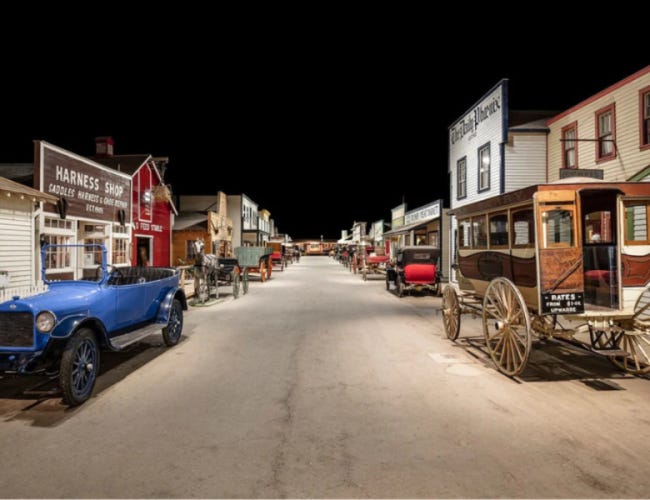
Just don’t worry about it.
It is a fact that in the early 20th century, Western Canadian expansion and prairie development were titanic undertakings filled with hardship and innovation. These museums were pitched as “keepers of the past,” but in truth, they’ve been havens for community, connecting generations - albeit with inaccurate information.
The problem is the original WDM concept inaccurately shaped Saskatchewan history as some kind of fairy tale, pure-white as the driven snow, with us all living happily ever after.
For decades, the WDM has only told one story: a story of settlers, progress, and mechanical marvels. Its inaccuracies and gaps in the legitimate timeline, combined with stagnant direction have taken a toll on its operations.
In 2021, the WDM posted a minuscule surplus, but every year since then has been a red-ink parade. The deficit peaked at $1.5 million in 2022-23, and it’s only marginally improved, still hovering near the million-dollar mark.
The legacy and challenges of the WDM were brought up at a Saskatchewan Public Accounts Committee (PAC) meeting early in 2025. In its 2024 report, the provincial auditor recommended more rigorous financial oversight and highlighted its ongoing fiscal challenges.
The PAC conversation underscored the need for greater oversight, innovation, and inclusion within WDM’s operations.
The WDM’s 2020 Collections Development Plan makes it clear that inside these iconic Saskatchewan buildings, staff are fighting inertia.
There is frustration and uncertainty about inclusion, with scant resources and slow-moving policy reviews. The permanent collection still tilts toward the settler mythos, and communities whose stories actually shaped Saskatchewan: Indigenous, LGBTQ2, and postwar immigrant groups, are barely represented.

Advisory councils provide input, but decisions get stuck between old guard and evolving Sask Party government priorities, leaving staff to improvise without a roadmap.
What a shame.
Our Western Development Museums are perfectly positioned to tell a bigger, truer story - one about struggle, change, but above all else, development in Western Canada. It’s right in the name, ffs.
Saskatchewan is a province built on innovation, on adversity, and yes, on alienation. We’re legendary for our complaints to or about Ottawa, but we rarely seize the opportunity to showcase our accomplishments, our pain, and our relentless hope.
Why shouldn’t the WDM transform itself into Canada’s premier venue for reckoning with the past and dreaming about the future of western development?
Instead of bemoaning our neglect, these museums could actively walk visitors through the realities of 20th-century settlement: highlighting not only triumphs like co-op movements and agricultural booms, but also the wounds left by displacement, exclusion, and environmental destruction.
That isn’t an admission of failure, it’s growing up.
There’s room for interactive exhibits on climate change, panels on Indigenous land stewardship, showcases of multicultural success stories, and workshops on cutting-edge prairie tech.
It’s choosing truth over nostalgia, candor over comfortable myths, and planning to do better. Imagine if every visitor left the museum challenged, moved, and inspired to do more than just remember.
But Saskatchewan is stubborn.
We’re proud, practical, and allergic to change, yet also smart enough to recognize a missed opportunity when we see it go by, which we often do.
This indifference is not only a shame, it’s a colossal missed opportunity.
The Western Development Museum is a small but pivotal detail in the province’s identity. The Sask Party government, which, if given a choice between investing in cultural assets like the WDM and a partisan, pointless project for their donors, would choose the latter every time.
I mean, technically it could very easily be both, but what do I know?
The WDM could be so much more than a charming relic or a budget drain. With real leadership, it could become an engine for reconciliation, multicultural understanding, and economic renewal. It could reclaim the word “development,” rooting it not just in what was built, but in what was endured and what is possible now.
We’re the place that gave the world Medicare. The nightmare they’re fighting in the United States around access to healthcare? Yeah, Saskatchewan kind of started all that.
The stories are here, waiting to be told, if only the museum’s mandate matched the scope of what western development has meant and could still mean.
There is no point in tossing out 75 years of accumulated objects, stories, and memory. Including the people, events, and struggles left out the first time is not about erasing history, but about facing it.
Museums are not mausoleums. In more mature countries and cities they are invitations to learn, to listen, to argue, to celebrate. The WDM’s fiscal troubles are real, but they are not a death sentence.
They’re a nudge.
As yet another Saskatchewan institution faces its 21st-century conundrum - resource pressures, climate worries, Saskatchewan Party mismanagement, endless debates about relevance - the Western Development Museum stands as a reminder of how much our story matters.
Empower the WDM to become what Saskatchewan needs: a mirror, a classroom, a stage, and above all, a beacon.
Not for nostalgia’s sake, but for all the possibilities of western development still left to claim.
Have a great week,

If you’re a paid subscriber, please feel free to leave your thoughts in the comments.
If you’d like to support my work, including costs like the multiple subscriptions and accounts I need to access and purchase information provided in posts like this one, etransfers are gratefully accepted at tammyrobert0123@gmail.com. Thank you.
💯 agree with Tammy. WDM has always had a blinders on narrative for the Glorification of English Speaking Settlers
A great story to be proud of but not the whole story for the WDM to be accurate there are parts of the Saskatchewan “ Development Story” that should be shared. Telling a more inclusive story might actually draw people to the museum. Just a few that come to mind:
1. Internment camps for “ aliens” WWl - After selling the dream to immigrants who in good faith uprooted families and moved to Canada and were just establishing their homesteads ( shittier land allocation to ski’s, sky’s and any Eastern European sounding name) when they were rounded up arrested and sent to internment camps across Canada 2. Is there anything at all about residential schools? Or the reserve system that put indigenous people at a huge disadvantage to the glorified settlers. 3. Saskatchewan was ( maybe still is) one of the most successful strongholds of the KKK. The was target mostly Eastern European Catholics
4.Weyburn mental health hospital
My husband and I raised our four children and spent many a Sunday touring various museums within driving distance of home.
I’ve always had a fascination for things from the past and value the stories and the artifacts.
Knowing where we’ve come from is important in knowing where we’re going.
You’ve brought up some good points and updating the history to include LGBTQ+, residential schools and more first nations history would be very welcome as are the comments by Old Biddy.
Museums should portray all aspects of history.
The Human Rights Museum in Winnipeg is a perfect example of the atrocities and inhumanity of humans and is unfortunately a picture of things to come in our present world.
Too many are unable to see the cycle repeat itself.