
Making Shareholders Pay: The Case for Dividend-Based Liability
Saskatchewan’s natural resources are geographically fixed. It’s time our corporate accountability laws were too.

Yesterday morning, a Saskatchewan man showed up for his shift at Mosaic’s K3 potash mine near Esterhazy. By lunch break, he was dead - buried under rock in what the company calls a “fall of ground incident.”
His family won’t be calling it an “incident”. They’ll be calling it a funeral.
I’m calling it something else: Mosaic shareholder-subsidized negligence.
Because while Mosaic distributes hundreds of millions of dollars annually to its shareholders, the Government of Saskatchewan treats workplace deaths at multinational corporations like parking tickets.
We need to change that.
Now.
A husband and father of two young kids, this man’s family now joins the grim roster of Saskatchewan families who have lost breadwinners and loved ones to multinational corporations extracting our province’s wealth. My heart goes out to them today, waking up in pain and anguish to a new life they didn’t ask for and don’t want.
It is time Saskatchewan law recognizes a fundamental truth.
The shareholder dividends paid by companies like Mosaic are subsidized by inadequate safety investments that cost workers their lives.
No amount of corporate language softens this reality. The guy showed up. He died.
But-for the employment relationship with Mosaic, he would be alive.
Meanwhile, Mosaic’s shareholders will continue receiving their quarterly dividend checks.
In 2024-2025, Mosaic paid $0.88 per share in annual dividends. With approximately 317 million shares outstanding, Mosaic distributes approximately $279 million annually to shareholders - money that flows out of the company while Saskatchewan residents die underground extracting the potash that generates these profits.
Saskatchewan’s current legal framework treats this death as an acceptable cost of doing business.
Maximum penalties under the Saskatchewan Employment Act reach $1.5 million for corporations when death results from occupational health and safety violations, but actual fines are far lower.
Recent Saskatchewan workplace death penalties include just $84,000 for one fatality, and the province’s median workplace fatality fine of $42,000 remains less than half the national median.
For the first nine months of 2025, Mosaic generated revenues of $11.89 billion. The company’s total market capitalization exceeds $8 billion.
This death at Mosaic’s K3 mine is not Mosaic’s first Saskatchewan fatality; the company has a documented history of workplace deaths in the province.
2009, Esterhazy - a worker was killed when a large storage bin broke apart and buried him in potash ore.
2011: Colonsay - a potash miner died following an accident underground at a Mosaic facility.
Beyond Saskatchewan, Mosaic’s U.S. operations show a pattern of safety violations. The company has accumulated $973,352 in safety-related penalties across 68 violation records tracked by Violation Tracker.
In January 2025, OSHA in Florida fined Mosaic just $30,649 after a worker fatality at one of its fertilizer plants in that state.
When fines are trivial, corporations treat them as operating costs - a rounding error. When penalties threaten shareholder returns, behavior changes.
If you’d like to support my work, including costs like the multiple subscriptions and accounts I need to access and purchase information provided in posts like this one, etransfers are gratefully accepted at tammyrobert0123@gmail.com. Thank you.
Saskatchewan should enact legislation immediately creating strict liability with dividend-based compensation for workplace deaths at publicly-traded, multinational corporations, particularly those stripping our province of its natural resources. No need to prove specific negligence. The death occurred at work - that establishes causation.
So let’s argue the corporate employer must pay the deceased worker’s family a lump sum equal to 5-15% of the corporation’s total dividends paid to all shareholders in the previous fiscal year.
For Mosaic, based on last year’s $279 million annual dividend payments to shareholders, just 5 percent would equal $13.95 million to this man’s wife and kids.
10 percent, $27.90 million to the family.
Compensation could be distributed to the deceased worker’s dependents according to existing Workers’ Compensation Board frameworks for death benefits, but at levels that actually reflect the true value of a human life and the corporation’s capacity to pay.
Think about it.
Fall of ground incidents are not acts of God.
Corporations could be forced to purchase insurance in Saskatchewan to cover this liability, creating an insurance market that would price safety performance.
Companies with strong safety records would pay lower premiums; companies with poor safety cultures would face higher insurance costs. This market-based mechanism would align financial incentives with worker safety more effectively than any regulatory fine structure ever will.
Because shareholders are not innocent bystanders.
They elect directors, who appoint executives, who establish safety cultures and allocate resources.
Every cost-cutting measure that improves profit margins - including inadequate investments in ground stability monitoring, insufficient rock-bolting, or rushed mining schedules - directly benefits shareholders through higher stock prices and dividend payments.
When Mosaic pays dividend profits to shareholders while Saskatchewan people die in “fall of ground incidents,” those cheques are underwritten, in part, by those deaths.
Even the most hardcore capitalists reading this understand the moral imperative here.
Research from Saskatchewan’s own potash mining industry shows that ground penetrating radar mounted on boring machines can identify geological conditions that lead to roof collapses. After a near-catastrophic fall-of-ground incident at a PotashCorp mine in 2013 that could have killed multiple workers, the company invested in real-time GPR (ground-penetrating radar) monitoring.
The technology exists. It works.
So why isn’t it mandatory at every Saskatchewan mine?
And when companies choose profit over protection, why shouldn’t shareholders pay the price?
Saskatchewan would not be breaking new ground by imposing substantial financial liability on corporations for workplace deaths. Multiple jurisdictions have enacted far more punitive regimes.
The United Kingdom’s Corporate Manslaughter Act allows unlimited fines for organizations convicted of corporate manslaughter, with sentencing guidelines recommending fines from £3 million to £20 million for large organizations.
Australia provides no-fault workers’ compensation death benefits while preserving the right of families to pursue common law “dependency claims” when employer negligence caused the death. This ensures baseline support while maintaining the deterrent effect of United States-style tort liability.
What distinguishes this proposed approach is the creation of a direct link between shareholder dividends and family compensation. While other jurisdictions impose substantial fines paid to government treasuries, Saskatchewan should transfer wealth directly from shareholders who profited from inadequate safety measures extracting provincial natural resources to families grieving due to those same decisions.
Saskatchewan could amend its Employment Act to create strict liability with dividend-based compensation specifically for publicly-traded, multinational corporations in resource extraction. We must establish automatic liability when workplace death occurs at facilities operated by corporations meeting the revenue threshold (minimum $1 billion+ annually).
We must also create minimum compensation floors ($10 million minimum, IMO) to ensure meaningful compensation even when the company’s dividends are reduced or suspended.
Following the Australian model, Saskatchewan could preserve baseline WCB death benefits as a safety net, while also creating a mandatory supplemental payment from corporate employers equal to percentage of shareholder dividends
”But but but… a <insert new royalty or accountability mechanism here> will drive corporations out of Saskatchewan.”
Shut the fuck up, because you honestly sound so dumb right now.
Last I checked, Saskatchewan’s potash - all its natural resources, believe it or not - are geographically fixed… in Saskatchewan.
Mosaic’s K3 mine - the site of its most recent fatality - represents a $2.2 billion investment completed in 2022. In fact, the company describes its Esterhazy complex as “the world’s largest potash operation”.
Mosaic cannot relocate the K3 mine to a more permissive jurisdiction, no matter what Saskatchewan law says or does. Mosaic will continue operations in Esterhazy because its profit margins mandate it, even if faced with enhanced liability regimes (don’t even get me started on royalties).

If Saskatchewan’s potash is soooooo valuable that corporations will accept worker deaths as collateral damage, then Saskatchewan workers deserve protection that reflects that value.
Saskatchewan possesses full legislative sovereignty to amend its workers’ compensation system and employment laws.
The objection that shareholders have no control over mine safety, fundamentally, if not wilfully (depending on who’s uttering it) misunderstands corporate governance. When Mosaic saved money by not deploying every available safety technology, shareholders benefited through higher dividends.
Creating shareholder liability for dividends received while workers die underground would force shareholders to demand that boards prioritize safety over short-term profit maximization.
There are already strict liability principles embedded in product liability law and environmental regulations (well, not in Saskatchewan, but you know, in the real world).
If manufacturers face strict liability when defective products harm consumers, why shouldn’t extractive corporations face strict liability when inadequate safety measures kill workers?
This market-based approach harnesses Saskatchewan conservatism in a way that benefits residents who work for these corporations, rather than exploiting them. Instead of corporations competing to minimize safety costs, they would compete to demonstrate superior safety performance to reduce insurance premiums.
We could include a two-year transition period between passage and full implementation, allowing corporations to upgrade their safety systems, deploy advanced monitoring technology and purchase insurance coverage for dividend-based liability.
Somewhere in Saskatchewan tonight, a family is grieving - a spouse trying to explain to children why Daddy isn’t ever coming home again, parents burying a child, adult siblings planning a funeral for one of their own, far too soon.

Meanwhile, Mosaic’s corporate statement expresses thoughts for “our colleague’s family and friends, all employees, and the broader community”, but thoughts don’t feed children or pay mortgages or replace the decades of earnings and companionship stolen by its “fall of ground incident.”
Saskatchewan must decide: are we a Margaret Atwood-inspired colony that allows multinational corporations to extract our resources while treating the related deaths of Saskatchewan residents as the cost of doing business?
Or are we normal human beings?
When it comes to Saskatchewan, I genuinely don’t know anymore.
Our humanity is seemingly dead.
IDGAF.
The man who died at the K3 mine deserves justice.
His family deserves compensation that reflects the value of a human life, not the Sask Party’s political calculation of acceptable penalties.
And every worker still underground in Saskatchewan’s mines deserves to know that if they don’t come home, their families will be taken care of - and the shareholders who profited from their labor will pay for it.
Dividend-based strict liability for workplace deaths is simple justice.
Multinational corporations operate wherever profit margins justify operation. Saskatchewan’s potash reserves are among the world’s richest. Mosaic will keep mining here - it will just have to do it without killing workers to subsidize its bottom line.
Oh well.
The only question is whether the Sask Part government has the political courage to make it law.
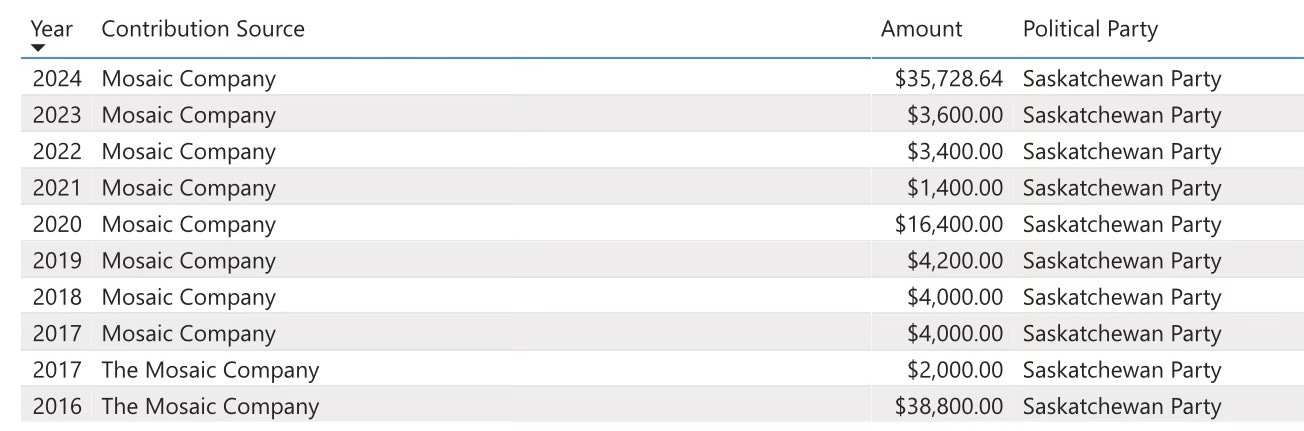

We both already know the answer.
Maybe the best we can hope for is that Mosaic pays more for the life of their employee than they’ve paid to the Sask Party in the last nine years.

This should be done.
These corporations are paying low royalties and failing to comply with safety regulations. They should not be allowed to do business and bleed away the value of our publically owned, non renewable natural resources.
I live next to the Nutrien mine. Members of our community are so grateful when the mine donates to the town. A Zamboni here, bike racks there.
Our town council struggles to provide basic infrastructure because of offloading by provincial government. Our access road from Highway 16, Highway 397 is mostly utilized by mine employee traffic and takes quite a beating. Financial responsibility for that is solely provincial.
Many residents of our community are employees of the mine. They work underground, never seeing the light of day and face the risk of what happened to the young man from Esterhazy. Are there wages high enough to compensate? Layoffs are a common practice which leave employees wondering when they’ll get back to work.
Like you said Tammy, let’s not even discuss royalties because it makes my blood boil.
Compensation for death and injury of employees, as you point out is abhorrent.
Why do we constantly settle for crumbs?
Capitalism at it’s finest.