

Imagine you get a speeding ticket in Regina.
The next morning, some Sask Party supporter’s spawn in short pants and a government lanyard walks into your kid’s school and says, “I’m doing an inspection under the Saskatchewan Immigration Services Act. Hand me everything you have on this family.”
Until July 15, 2026, the school would have been able to stop and ask questions.
Now, the new rules force the school to say yes.
This is a change nobody is talking about, and we should be.
First, let’s be clear about who created this problem.
The Saskatchewan Party spent years demanding more immigrants.
Not because they had a plan to absorb them, but because they needed cheap labour to paper over the workforce gaps created by their supporters’ greed and which their own underfunded healthcare and trades training system couldn’t accommodate.
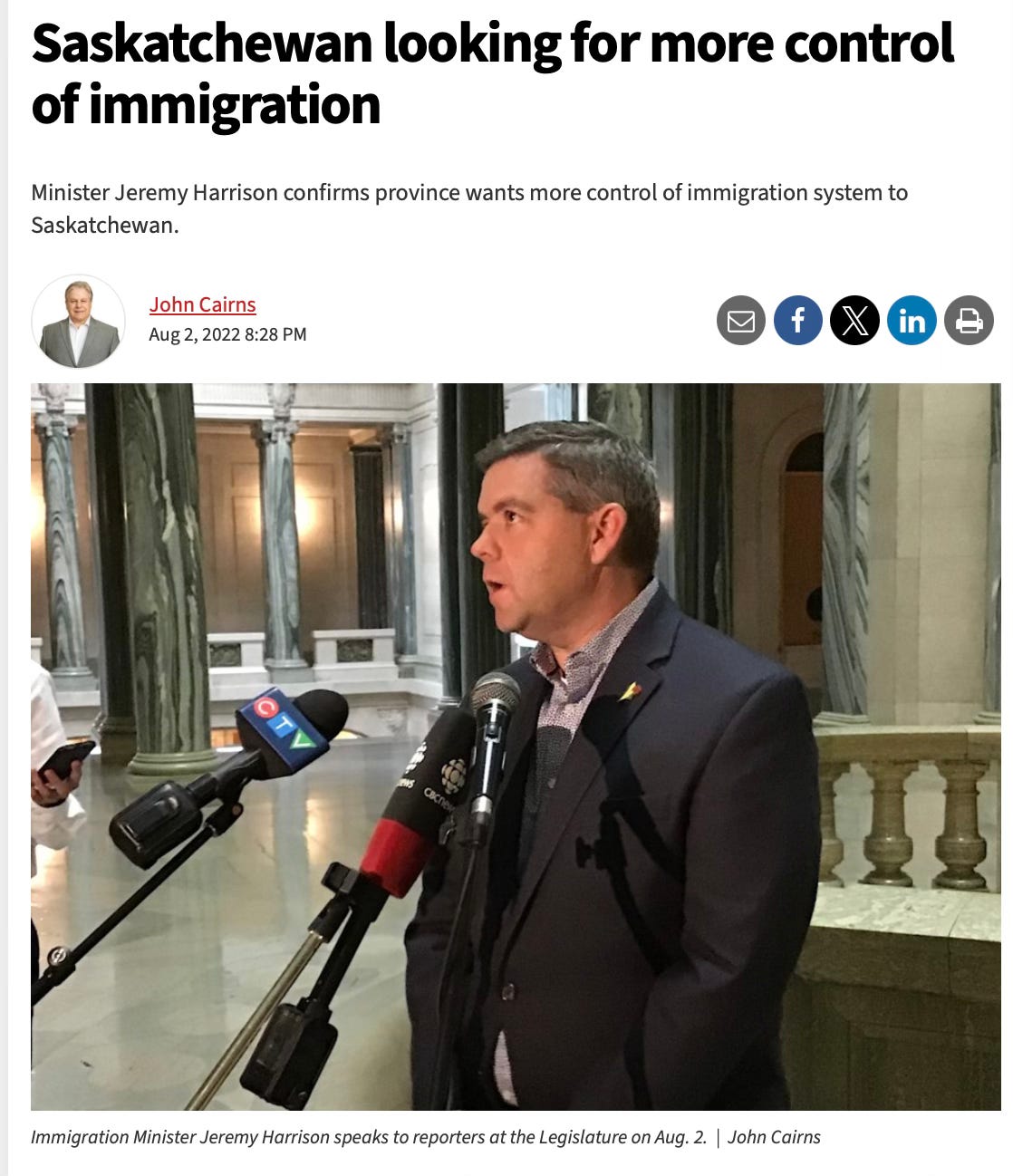
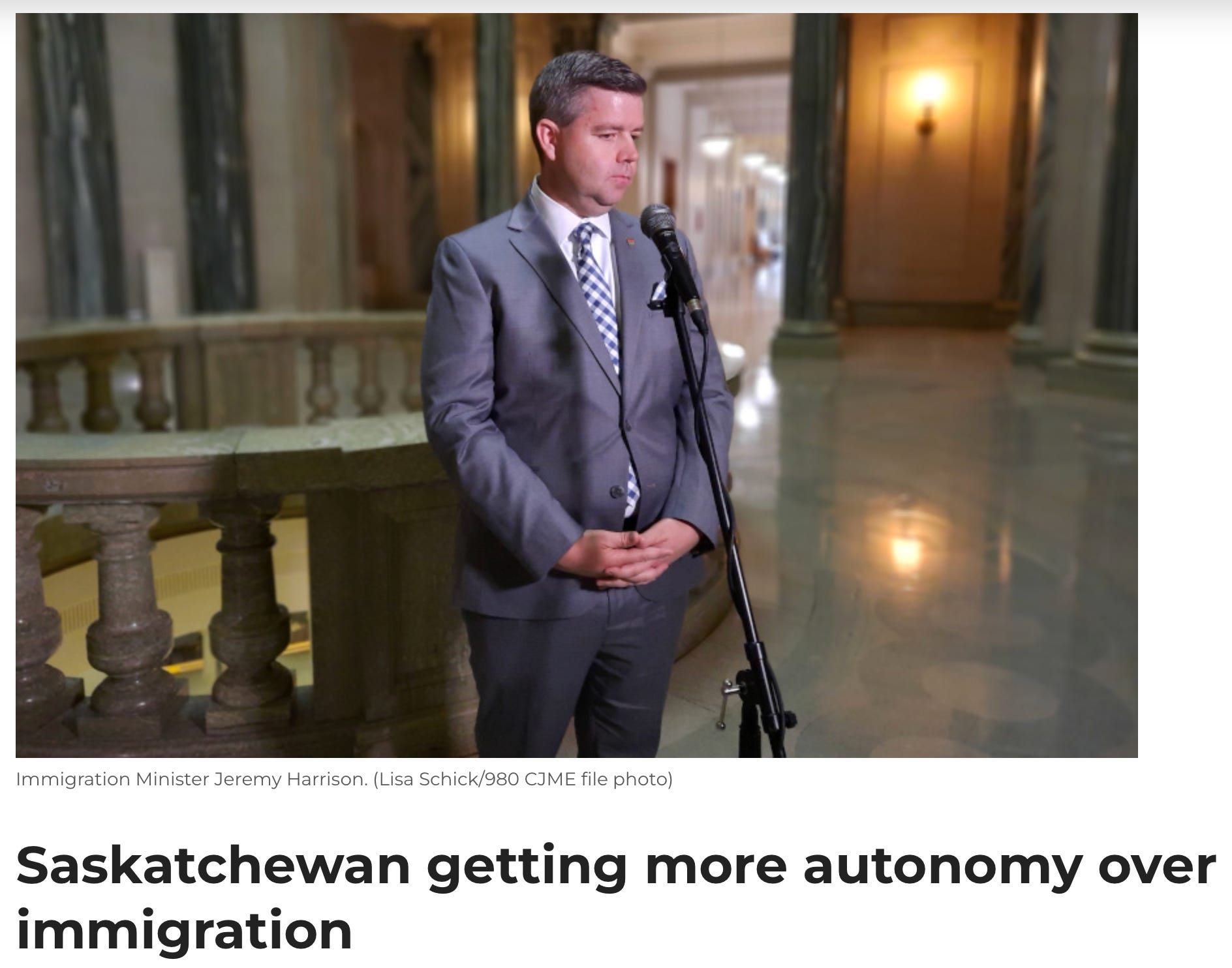
In 2022, Scott Moe’s government published the Saskatchewan Immigration Accord, a formal proposal to wrest control of immigration from Ottawa entirely and set the province’s own intake levels. They wanted 13,000 new immigrants per year through the Saskatchewan Immigrant Nominee Program (SINP).
Ottawa wouldn’t go that far (F*ck Trudeau, right?), but Moe and his sidekick, Jeremy Harrison, got a 42 per cent increase anyway, from Saskatchewan’s per capita quota of 6,000 nominations annually to approximately 18,000 newcomers over two years, including dependents.
What followed was predictable to the very few who were paying attention.
The pipeline the Sask Party built attracted predators.
In Humboldt and North Battleford, restaurant owners were charged in January 2026 with charging foreign workers illegal fees for employment, misrepresenting job opportunities, and threatening deportation without lawful cause. A Saskatoon consultant was convicted for counselling immigration misrepresentation, charging a Chinese family $40,000 for fake job offers and falsified pay stubs that went nowhere.
This problem goes back over a decade. It’s not new. In 2017, back when Geoff Leo was bothering himself with stories that mattered, or were at least about more than one person at a time, he revealed a fraud that until Saskatchewan cleared the path, only existed in immigration lore.

““It’s almost the stuff of immigration legendary myth that there are envelopes of cash being passed around for offers of employment in Canada,” said the Vancouver-based lawyer and immigration policy analyst.
But he said a case CBC recently uncovered in Saskatchewan is “the first time on record someone was caught” — as he put it — “green-handed.”” - Undercover investigation unmasks cash-for-jobs Chinese immigration scheme, CBC.ca, June 19, 2017
Fake employer schemes.
Ghost consultants.
Labour Market Impact Assessment (LMIA) fraud, resulting in the TFW crisis we have now.
The SINP’s rapid, uncontrolled expansion under camo-wearing, gun-totin Jeremy “Fudd” Harrison created a free and glorious market for scammers and con artists, and vulnerable people paid for it with their savings, their status, and in some cases their future in Canada.
Saskatchewan built the pipeline, cranked it open and then turned its back on the result.
And then there were the Ukrainians.

You’ve all figured out by now that few to none of these families were actually evacuated from Ukraine, right? They were already out - men legally and illegally - and settling into the vast space that exists for them in places like Poland the Czech Republic.
In 2022, the Sask Party government chartered five flights of supposedly displaced Ukrainians: photo ops in every press release; $335,000 in settlement supports announced with great fanfare; Scott Moe welcoming the newest members of the Saskatchewan family.
About 8,000 Ukrainians eventually came to the province over the course of about six months.
Then, quietly, the government changed the SINP rules in a way that blocked many of them from accessing permanent residency. By February 2026, Ukrainians who had built lives here - working, paying taxes, enrolling kids in schools - discovered the path they were promised had been closed behind them.
Of course, the Sask Party blamed the feds, relying on that old chestnut to shut the ears and eyes of their devout following.
If you’d like to ensure this works exists in the long-term, etransfers are gratefully accepted at tammyrobert0123@gmail.com or by using the donation button below. Thank you.
The NDP publicly demanded that Moe fix it. He refused, but only because he had no control over the changes, which trickled down from the feds. The Sask Party recruited these people like labour robots and then left them to rust in an immigration junkyard when it was inconvenient to follow through and take care of them.
This is the government that is now appointing “enforcement officers” to police the immigration system.
On July 15, 2026, Scott Moe’s Cabinet signed an Order In Council (OIC) amending The Local Authority Freedom of Information and Protection of Privacy Amendment Regulations, 2026.
It adds one line to a list of local public institutions that can legally hand your personal information to the Sask Party government.
The new line says your school board, hospital, municipality or any of dozens of other local bodies can now share your personal information with Government of Saskatchewan-appointed immigration directors and “enforcement officers” working under Saskatchewan’s Immigration Services Act.
This impacts you. Anyone in Saskatchewan whose name, address, employment record, school record, or health file sits in a public body’s database.
That’s most of us.
The institutions on the hook to do the handing-over:
Every school board in the province
Every regional health authority, including the Saskatchewan Cancer Agency
Every city, town, village and rural municipality
Every post-secondary institution
Every library board, police commission
If you’ve ever registered a child for school, attended a hospital, paid property tax, or applied for a municipal program, your personal information lives in one of these files.
Saskatchewan’s Local Authority Freedom of Information and Protection of Privacy Act (LA FOIP) is the rulebook designed to keep your information private.
Section 28(2)(g) of that Act now says a local body may give personal information to a law enforcement agency when the head of the institution has “reasonable grounds” to believe the disclosure is needed for the enforcement of laws.
The word “may” is important. It is not “must.” The institution still has to make a judgement.
But here is the new piece: a Saskatchewan government immigration director or enforcement officer is now officially on the list of bodies deemed law enforcement in Saskatchewan.
This is where it gets stupider.
Saskatchewan’s Immigration Services Act, passed in 2024 and in force since July 1, 2025, sets up a whole provincial immigration machine. The Act creates two titles: “director” and “enforcement officer”, both appointed by the provincial minister - right now loyal Scott Moe bootlicker Eric Schmalz.
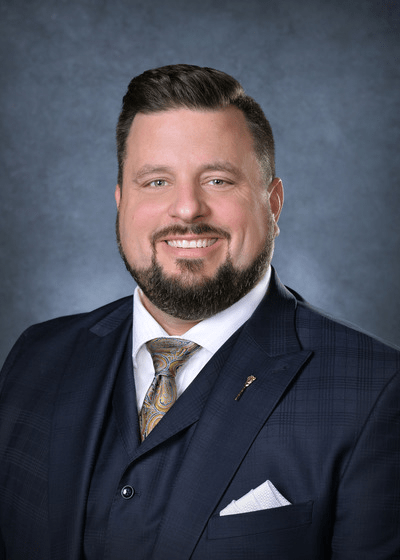
Schmalz’s “enforcement” officials can walk into any office, or any place of business, no warrant needed. Once in the door, they can demand records, contracts and employee files. They are allowed to share whatever they collect with anyone Scott Moe’s Cabinet approves.
My favourite part is the Act grants Saskatchewan’s immigration “enforcers” broad legal immunity when they act in “good faith”.
What “enforcers” cannot do: decide anyone’s immigration status, deport anyone, or arrest anyone for being in Canada without papers. That is still a federal job held by the Canada Border Services Agency under the Immigration and Refugee Protection Act.
If this is sounding familiar, it should.
This is the Saskatchewan version of ICE.
Not the name, not the federal jurisdiction, not the deportation authority… but the architecture. Enforcement officers who can walk into any workplace without a warrant, demand records, share what they collect with whoever the Cabinet approves, and claim immunity because they were acting in "good faith."
That is the ICE playbook.
Saskatchewan didn't invent this.
They copied it, stripped out the deportation power, and handed the keys to Eric Schmalz. The fact that they can't put anyone on a plane doesn't make the infrastructure less dangerous.
It makes it more insidious, because infrastructure built to track immigrants can be turned on anyone, for anything, with no one watching.
Doesn’t matter where you were born.
Before this OIC, if a law enforcement official - aka “a cop” - walked into your school and asked for your personal records, the school would have to look at the law, look at the request, and decide whether it qualified as a real law-enforcement request.
There was an established gatekeeper: the head of the institution had to be satisfied on reasonable grounds that disclosure was necessary. Now there’s a pre-printed short list that says: yes, this kind of request qualifies. The named officials count as a “law enforcement agency” by default.
What the new rules do not require:
A court order
A subpoena
A warrant
A written request with reasons
A review by the Information and Privacy Commissioner
Any independent check that the person asking is actually who they say they are
Any notice to the person whose records are being handed over
Any record of what was disclosed
The Act says immigration directors and enforcement officers must carry a Government identification card and produce it on request. That is the only protection. A Sask Party government-issued lanyard and a verbal assertion that an “inspection” is happening.
When any kind of provincial government-appointed “enforcer” has the power of the state and no requirement to put anything in writing, we have a recipe for disaster. Wrong person. Wrong disclosure. No record. No review. No way for the affected resident to even know it happened.
It also duplicates work Canada already does.
Canada already has CBSA officers, RCMP, and IRCC staff doing immigration enforcement work. Saskatchewan is now paying - out of our shrinking pot of provincial tax dollars - to set up a parallel provincial immigration inspection office to police the exact same recruiters, consultants, employers and immigrants.
That is what “duplication of tax dollars” looks like.
Sask Party MLAs should be asked, on the record: wtf is this buying us that we didn’t already have?
In a real government, the Minister of Justice and Attorney General would publish a written accountability framework, including who pays damages when the request turns out to be wrong, who logs disclosures, and who audits the data flow each year.
I guarantee our AG doesn’t even know about this change, or at the very least, paid any attention to it.
The Minister of Immigration and Career Pathways should publish the list of appointed immigration directors and “enforcers”, with their photos, appointment dates and the agency rule that names them. We are damn well entitled to know who holds these new powers.
Every school board, health region and municipal council in Saskatchewan should vote, this fall, on a written policy: before any data leaves the building under this new clause, the request must be in writing, the ID must be checked against the public register, the head of the institution must sign off, and a public disclosure log must be kept.

Without that policy, this change becomes a snitch-driven regime with no audit trail.
Section 95 of the Constitution Act, 1867 does let a province legislate on immigration. But the constitution doesn’t say you have to do it without adult supervision or a scintilla of integrity.
Saskatchewan residents deserve at least that much.
What they’re getting instead is governance by signature.
This is not new.
For years - really, since COVID - Scott Moe’s Cabinet has been quietly rewriting the rules of daily life in Saskatchewan through Orders in Council and regulatory amendments.
These are changes that affect your healthcare, your privacy, your employment, your children’s schools — and none of it requires a vote in the Legislative Assembly. No debate. No committee review. No public consultation. No scrutiny from Opposition MLAs.
Just a Cabinet meeting, a signature, and a posting in places no one (except yours truly) reads.
This is how authoritarian governance works.
Not always through dramatic power grabs.
More often through the slow, boring accumulation of regulatory authority: small changes, buried in legalese, dropped on a Tuesday, forgotten by Wednesday. The people who use this playbook understand that democracy’s real weakness isn’t elections. It’s passiveness. Do enough small things quietly, and by the time anyone notices what’s been built, the architecture is already in place.
The OIC that just gave Sask Party-government appointed “enforcement officers” access to your school records, your health files, and your municipal data didn’t make headlines.
It wasn’t supposed to.
That’s the point.

This is deeply disturbing because of the extremely minimal checks on the ability of a government to dip into the private information and contacts citizens have with the various institutions with which we inevitably deal. There does not seem to be a clear reason for this authority being given to agents of the government and which could amount to “fishing expeditions” targeting people whom the government regards as troublesome. There should be at least a warrant called for, executed by an officer of the law. To collect someone’s records it should be necessary to prove there is a legal investigation of that person’s activity for which that information would be germane. In other words “charge me or piss off.”
I know immigration is out of hand but opening up records and creating Brown shirts to clean up the mess is disturbing and very dangerous.