
Saskatchewan’s Democracy Deserves Better Than This
A pattern of blocking election transparency should alarm every voter, and a donor loophole that shocked me, even after twenty years of studying this nonsense.

No paywall today. Just do me a favour and share the information with your friends and family. The only solution to the Saskatchewan problem is Saskatchewan people.
Anyone with even the most basic understanding of Saskatchewan politics knows what the real problem is: money.
More specifically, who controls it.
Because the people who control the money control the power.
If you’re a Sask Party politician, you already know the family business.
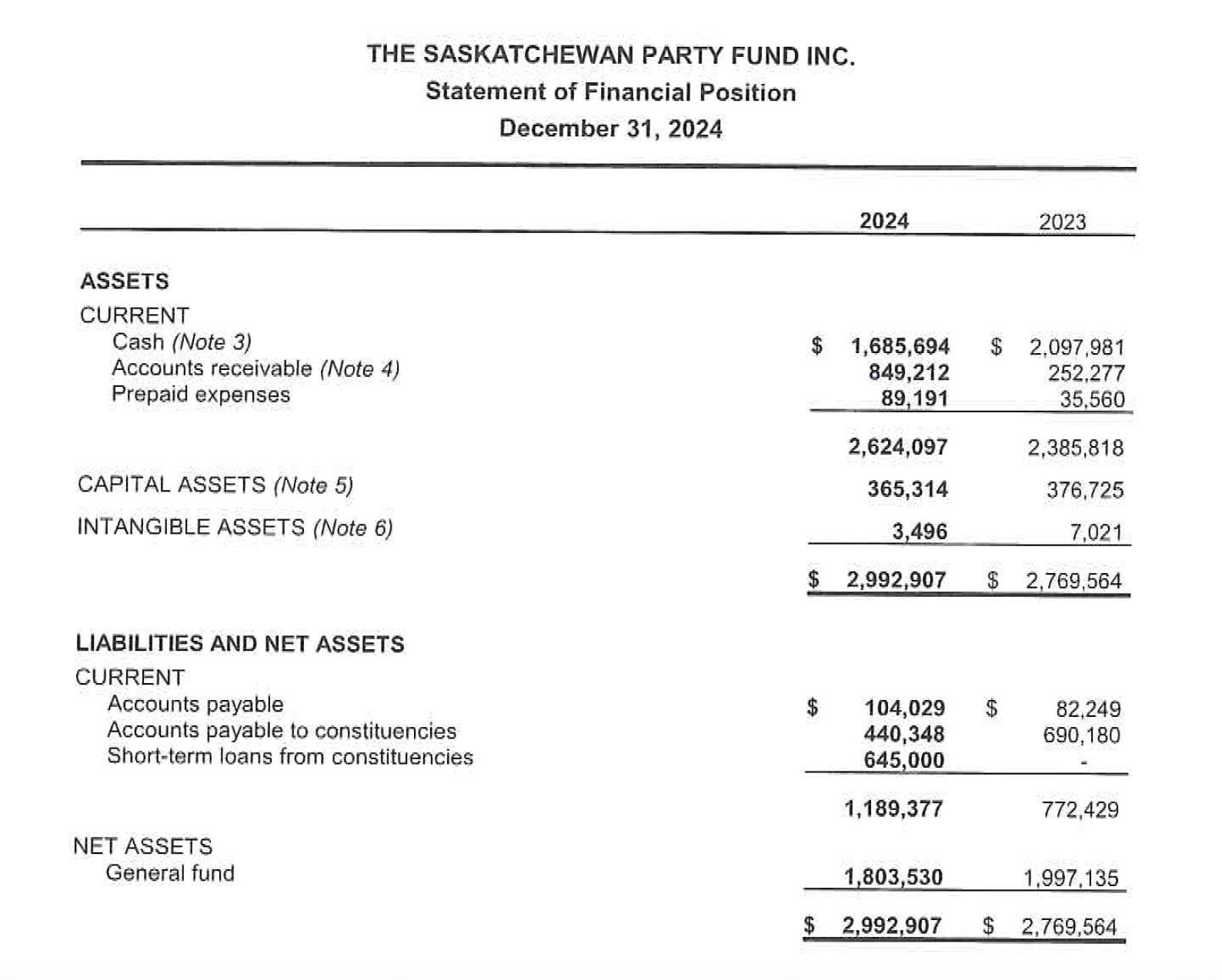
Every year, headquarters pulls in a few million dollars, then “revenue-shares” part of that money out to each of its 61 constituency associations. When election time rolls around, those constituency associations use the money to run campaigns. Then Elections Saskatchewan partially reimburses those campaign expenses, and the cash gets kicked back up the chain.
It’s quite the cycle when you actually look at it on paper. Which I did.
We’ll come back to it.
Under The Election Act, 1996, Saskatchewan runs a publicly financed rebate program that was supposedly designed to make running for office accessible regardless of personal wealth.
Yes, you’re allowed to laugh.
Both registered political parties and individual candidates can qualify for the rebate, but only if they clear a minimum threshold - at least 15 percent of votes cast province-wide for the party to be eligible, and individual candidates must also receive at least 15 percent of the vote in their own constituency.
If that threshold is met, an eligible political party can be reimbursed with public money (your money) for up to 50 percent of its election expenses, while an eligible candidate can recover up to 60 percent of theirs.
Practically, what that means is that in many Saskatchewan ridings — especially in rural Saskatchewan — running an NDP campaign is a money-losing venture almost every single time.
Any surplus campaign funds left over after the rebate must be remitted back to the party or constituency association or, in the case of independent candidates, to the provincial treasury. This prevents the reimbursement program from functioning as a personal windfall.
What the Saskatchewan Party’s own 2024 election year return shows, though, is what happens when that structure hardens into a machine.
In 2024, an election year, the party reported $2.5-mil in individual donations and $1.6-mil in corporate donations, up from $1.8-mil and $485K respectively the year before. Those two streams alone accounted for roughly 90 percent of total revenue in 2024, up from about 62 percent in 2023.
Meanwhile, the smaller, grassroots-looking streams moved in the opposite direction: in 2024 Sask Party memberships plunged to $109K from $150K and the Victory Fund dropped to $27K from $39K .
What I found the most interesting is the fact that their many fundraisers - all those pay-to-play Premier’s Dinners, golf tournaments - don’t even break even.
The Sask Party’s fundraisers lose money.
Are you still laughing? Lol omg these idiots.
The only thing propping up those dinners is the revenue from corporations who “advertise” at them.
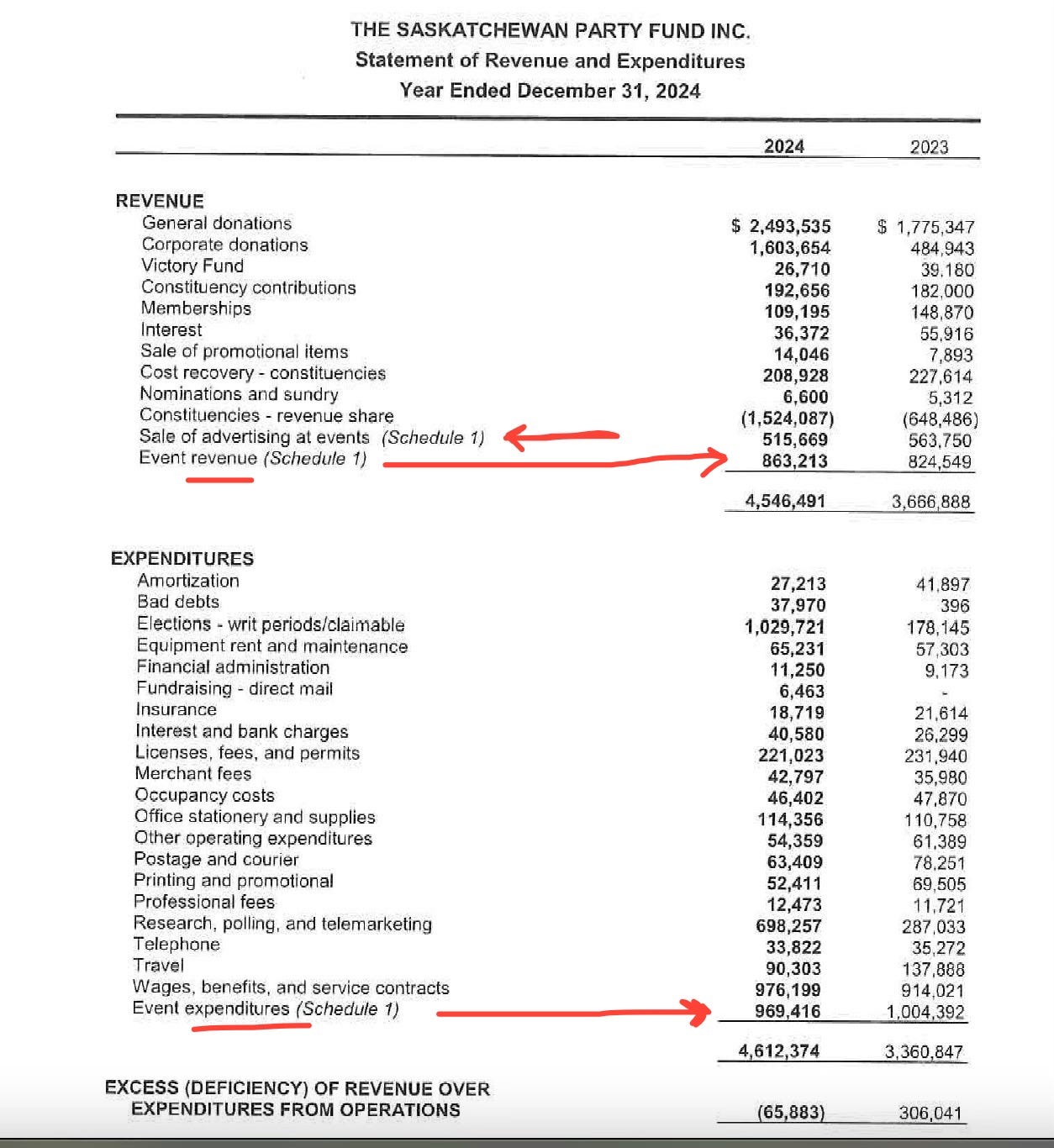
Yes, the political party that governs our province has an “advertising” line item in their revenue column and that’s how they make money, in case you didn’t think this was already too fucked up.
The Sask Party’s story is not a story about a broad membership base (people) keeping the party afloat.
It is a story about a party becoming more financially concentrated and more dependent on major donors.
And their dependency does not stop with donors. The same return shows headquarters leaning on constituency associations and the public purse to keep the whole operation moving.
In 2024, the party recorded $1.5-mil in “constituencies – revenue share,” $645K in short-term loans from constituencies, and $440K in accounts payable to constituencies. It also took $500K in election expenditure reimbursement (your money), while year-end receivables included $506K in election reimbursement and $274K in loans to campaigns.
That is the cycle in black and white: money pushed around inside the party, money floated upward from the ridings, and taxpayer-funded reimbursement arriving later to help settle the books. For all the rhetoric about self-reliance and free enterprise, the party’s own numbers describe a political machine running on concentrated private money, internal cash shuffling, and a public subsidy.
In the Saskatchewan Party, constituency association funds are constantly recycled back up to the centre.
And if you’re thinking that this also means your tax dollars are helping keep the Sask Party’s fundraising machine alive, congratulations: you’ve understood the system exactly as it was built.
This is just one of the many, many problems with money and politics that is unique to Saskatchewan. Alberta and British Columbia don’t issue rebates at all. Compared to other provinces that do, Saskatchewan’s publicly-funded program is incredibly generous.

But the money is only part of the problem. As we’ve established, the Sask Party doesn’t really need your money. Between its legacy fundraisers and wearing down the electorate to dangerous levels of helplessness, it’s had the province on lock for years.
The Sask Party needs their donors to not just want but desperately need a Sask Party government, to facilitate the corruption that makes those donors rich and keeps their party in power.
See, I know it’s not about money because I well know the biggest Sask Party donor to-date. I think it’s safe to say that donor and the Sask Party are not friends anymore.
Why?
Because that donor didn’t need anything from Sask Party.
Unlike most Sask Party donors, this one headquarters their companies in Saskatchewan - meaning they actually pay taxes here. They own wildly-successful North American businesses across multiple industries without an iota of support from the Sask Party.
This person gave the Sask Party a very generous gift and then had the audacity to simply want good things for Saskatchewan people in return. He or she didn’t need anything else from the Sask Party, besides hoping for a bit of accountability.
Well, we all know how the Sask Party feels about accountability. They made sure that donor did too.
You are only valuable to the Sask Party if you have money and need something from them. The Sask Party needs their biggest cash supporters to also require new legislation or changed regulations - political favours. You know exactly who they are, and so do they. They’re not successful, they’re not savvy- they’re a bunch of mediocre, middle-aged corporate welfare bums.
A permit, an approval, or a look away - that is what the vast majority of Sask Party’s high-level “donors” are specifically purchasing, boldly and in plain sight. And Saskatchewan is one of the only jurisdictions left in the Western world who allows it to happen.
Brad Wall and his wannabe cowboy cronies used to call lawless Saskatchewan “the Wild West”. It made them feel really cool and masculine, no doubt - fulfilled a whole bunch of emasculated fantasies about themselves.
Saskatchewan is not the Wild West.
Far more accurate would be calling it a Failed State.
A third-world country, even, ruled by backwater-authoritarians who use Canada’s apathy to Saskatchewan and corrupted levers of money and economic control to hold on to power.
I’m not a huge Michael Boda fan. I think our Chief Electoral Officer knows damn well how bad democracy is in Saskatchewan and could make a hell of a lot more noise about it. I don’t understand why so many Saskatchewan people can just sit there and allow themselves to be used to helm these disastrously-flawed government agencies.
Then I remember their six-figure salaries to do nothing more than shut their mouths and I kind of get it, I guess.
If you’d like to ensure this works exists in the long-term, etransfers are gratefully accepted at tammyrobert0123@gmail.com or by using the donation button below. Thank you.
To be fair to Boda, he has made some effort to make change.
Late last year he delivered his verdict on the 2024 provincial election process. Buried in 180 pages of technical recommendations is a damning indictment of how the Sask Party treats democratic accountability: with contempt.
Michael Boda’s post-election report reads like a parent explaining - for the third time - why their toddler needs to stop scribbling all over the walls. Except in this case, the toddler controls the Legislative Assembly, and the walls are the foundation of democracy.
For example, even before the 2024 election, Boda recommended using electronic ballot-counting machines.
Those aren’t the same as voting machines.
Voters still mark paper ballots with a pen. The scanners simply count faster and more accurately. Teachers used these scanners thirty years ago in Saskatchewan to mark our standardized tests.
Boda tested scanner machines in three 2023 by-elections. A former Chief Justice of Saskatchewan reviewed the results and confirmed they were 100 percent accurate.
The Legislature’s Board of Internal Economy - controlled by the Sask Party - killed it anyway.
Their reason?
A vague assertion from young Master Jeremy Harrison that “ballots cast by hand should be counted by hand.”
No evidence.
No experts.
Just Weeman Harrison and a folksy slogan that sounds principled, until you realize it means forcing volunteer election workers to hand-count thousands of ballots after working all day, increasing the risk of human error, and delaying results for candidates and voters.
Even better, rejecting ballot scanners also killed the “Vote Anywhere” option, which would have let Saskatchewan voters cast a ballot at any polling station in their constituency instead of being assigned to one specific location. Obviously, Vote Anywhere only works if you have electronic systems to track who’s voted and tabulate ballots from multiple locations.
But rejecting electronic ballot-counting is just the symptom.
The disease is a government that has systematically ignored calls for basic transparency on literally anything and everything it does.
That is common knowledge by now.
This next one, however, is not so common.
I’ve studied Saskatchewan politics for years. Somehow I missed the fact that there’s a loophole in our election laws big enough to drunk drive a Sask Party Suburban through, which allows political donations disappear from public view entirely.
Here’s how it works:
you can donate to a political party (reported publicly);
you can donate to a candidate during an election (reported publicly);
or, anytime you like, you can donate to a constituency association - and if you don’t ask for a tax receipt, that donation never has to be disclosed anywhere, ever.

It just vanishes into the association’s bank account, then pushed up to headquarters as a donation to the party from the association.
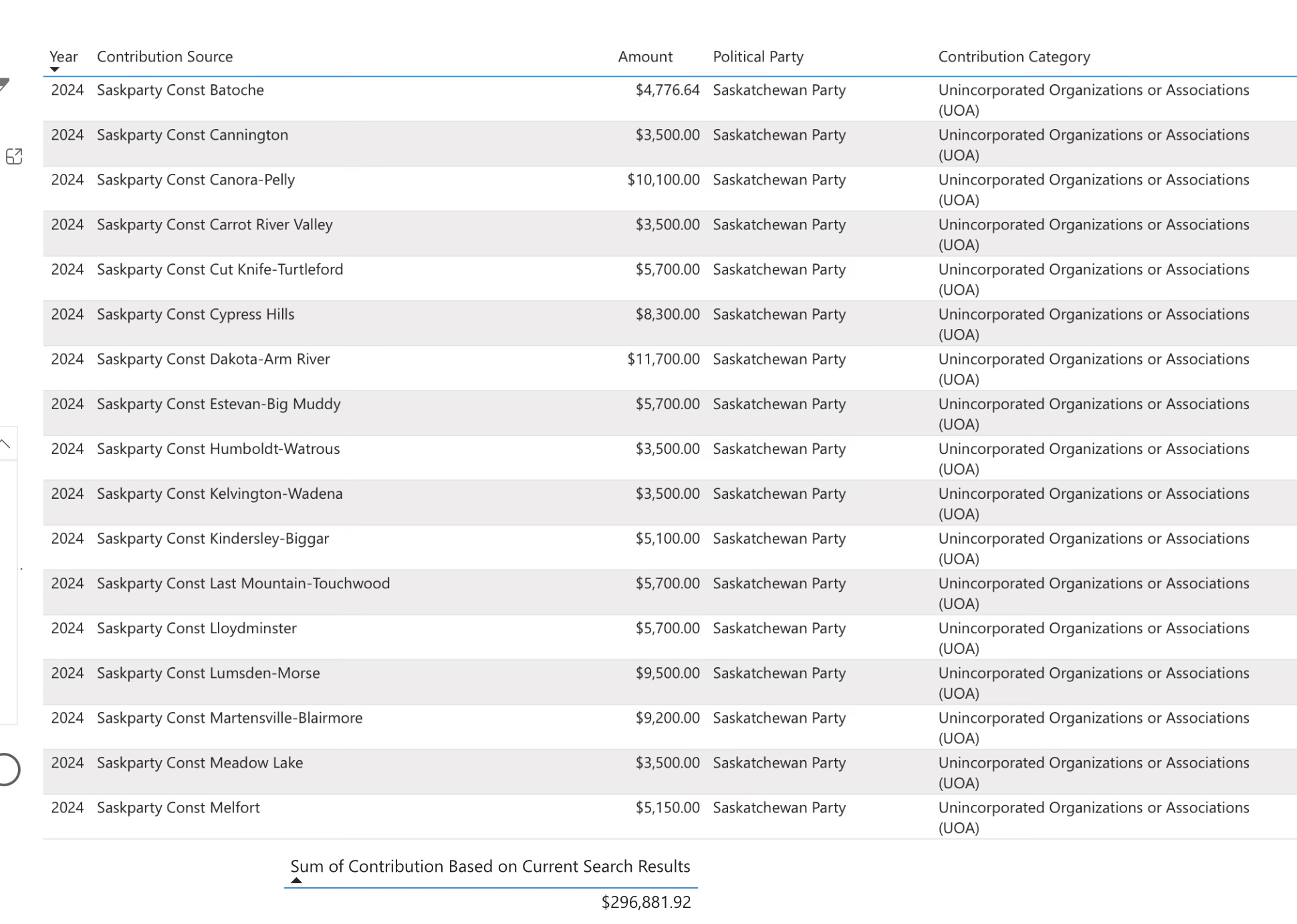
No public record of where the money came from. No transparency. No accountability.
This arguably means that any businessperson, let’s say from India or China, can donate whenever and however much money they want to the Sask Party by funnelling it through a constituency association - and we’d never know.
Yet, the Saskatchewan Party’s own constitution requires every constituency association submit to party HQ a complete list of all donations it received, including the names of donors and amounts, by February 1st of each year. The constitution also asks for audited financial statements from every riding association by April 1st.
In other words, the Saskatchewan Party’s internal rules demand full donor disclosure… to themselves.
But not a syllable flows to Elections Saskatchewan, or towards anything resembling public transparency or accountability.
This isn’t normal or acceptable. There is no excuse for this kind of electoral, political donor corruption in 2026.
With these so-called “rules”, or lack thereof, Saskatchewan is a democratic outlier among Canadian provinces, if not the entire continent of North America. The comparison is so bad that it’s embarrassing.
At the federal level, electoral district associations are required to file annual returns with Elections Canada and publicly disclose all donors over $200.
Alberta requires constituency associations to file annual financial statements with Elections Alberta by March 31 each year. There’s a $4,300 annual contribution cap. Corporations and unions can’t donate; individuals only.
Constituency associations must disclose all contributions to Elections Manitoba within 30 days of year-end, with the names of all donors over $250 made available for public inspection. There’s a $5,000 annual cap. Corporations and unions can’t donate; individuals only.
Ontario requires annual financial returns to Elections Ontario with donor disclosure. $5000 donation cap, corporations and unions banned and - you guessed it - individual donors only.
Saskatchewan?
No requirement for constituency associations to report their financials to Elections Saskatchewan.
No contribution limits.
Corporations and unions, from anywhere, can donate freely.
No cap on how much a single donor can give.
And if the donor is willing to skip the tax receipt, their money disappears into a black hole.
I’ve written about Saskatchewan’s awful, archaic and corrupt political finance landscape so many times that I feel like a broken record. Like I’m beating my head against a brick wall. Saskatchewan is not just lagging behind, it’s operating a political finance system every other major province recognized as corrupt and shut down years ago.
The NDP’s silence on this issue is equally telling.
To me, it’s more offensive than the Sask Party’s.
In 2024, when the provincial election outcome briefly looked uncertain and corporate Saskatchewan began to nervously contemplate the idea of change in government, the Saskatchewan NDP cashed in. It received over $100,000 from corporations, way more than double previous years and including donations from the Sask Party’s roster of high-powered law firms, developers, and even Rawlco freaking Radio.
Those corporations didn’t write those cheques because they had a sudden, mid-campaign, ideological change of heart and became leftists.
Instead, they were buying insurance to maintain their leverage, regardless of the outcome at the ballot box.
When they accepted the money, the NDP understood the assignment. That’s why, since the 2024 provincial election, they’ve been conspicuously quiet on banning corporate donations or closing any one of the many other transparency gaps in our antiquated election finance laws.
The Saskatchewan NDP will never bring up Saskatchewan’s grotesque political finance swamp again, because they’ve been told by the same people who run the fu*cking swamp - nay, the province - to STFU and take their money.
And keep taking it.
Speaking up, which we already know the Saskatchewan NDP is terrified to do on an average day, would mean risking those same donors in 2028, when the Saskatchewan NDP figures corporate hedging might be the difference between opposition and power.
Actual human voters? They DGAF.
This means Saskatchewan voters are stuck with a government that actively blocks campaign finance reform and an Opposition that refuses to push for it, both protecting a system that serves Scott Moe and Carla Beck’s interests over democratic accountability to voters.
There’s no other way to frame it.
The Saskatchewan NDP under Carla Beck has morphed into a grotesque, wannabe, yet somehow even more inadequate-version of the Sask Party.
And then there’s the disinformation threat; a problem that should terrify anyone who cares about fair elections.
Boda’s report warns that Saskatchewan is dangerously unprepared for AI-generated deepfakes and election disinformation. He points out that Premier Scott Moe’s voice and likeness were hijacked twice in 2025 for AI-generated cryptocurrency scams. If scammers can do it, so can political operatives.
Other provinces have given their election officials tools to combat disinformation. Boda asked for legislative authority to address election-related disinformation before the 2020 election. He asked again after 2024. The Sask Party has done nothing.
Let that sink in: we’re in an era where a fake video of a candidate saying something they never said can be created in seconds and spread to thousands of voters before anyone can debunk it, yet the Sask Party has deliberately handcuffed the Chief Electoral Officer’s legal authority to respond.
None of this is an accident. It’s a pattern.
At every turn, when given the choice between modernizing democracy and maintaining illicit power, the Saskatchewan Party chooses increasingly fraudulent, unearned power.
Think about that too - our legislation was created before the internet, before social media… legislation created before the turn of the 21st century, fffs.
Boda’s asked for municipal elections to be moved so they don’t collide with provincial campaigns. He’s flagged the need for better collaboration with First Nations communities to address persistently low voter turnout on reserves.
The response from the Sask Party? Crickets.
Michael Boda supposedly isn’t a political operative. He’s a public servant with a doctorate in electoral administration whose job is to make voting accessible, fair, and trustworthy.
When he says constituency association donations should be transparent, that’s not an NDP talking point. It’s a good-government reform recommended by election experts across Canada.
When he says ballot scanners improve accuracy, he’s not trying to rig elections. He’s trying to reduce human error and get results to voters faster.
When he warns about AI disinformation, he’s not fearmongering. He’s reading the same reports every other election official in the democratic world is reading and sounding the alarm before it’s too late.
The Saskatchewan Party’s refusal to act isn’t about principle. It’s about power. And voters deserve to know that the people who control the rules of our elections are actively blocking reforms that would make those elections more transparent and secure.
Democracy isn’t a favour the government does for us when it feels like it. It’s the foundation they’re supposed to protect, because Saskatchewan MLAs work for us, not the other way around.
Time to remember who actually runs the show around here - that’d be us, not them.

No one in the province should be allowed to vote until they understand the corruption of the moe government and the complacency of the NDP when it benefits them.
This needs to be class. An online ticketed event!