

Note: yes, I’ll be writing about Kevin Weedmark, his non-government staffer/wannabe-nobody influencer attending government events and yes, his “working man’s” private plane. Dear god. No sane politician would ever say that out loud, but Kevin Weedmark sure did.
I’ll share the facts - who the woman is who he’s flying around with, the owner of the plane it is and how much it actually cost, and all the other serious issues raised by Weedmark’s ridiculous behaviour.
That said, I’m also going to share why I’m disgusted, as usual, with how the Saskatchewan NDP are handling their response. For example, I watched a social media video yesterday from one of their MLAs - ostensibly, a retort to Weedmark’s travel habits - wherein the MLA is laying in the middle of a road under his car, duct taping the front of it back together. And… proud of it.
So which is it going to be Saskatchewan - the party of the “working man’s” private jet, or the party lying under a car in the middle of the road, armed with nothing more than a roll of duct tape?
Lol. OMG Saskatchewan. What are you doing?
At the Canada Investment Summit in Toronto on Monday, Premier Scott Moe stood beside Bell Canada CEO Mirko Bibic and compared an AI data centre to the building of the Canadian Pacific Railway.
This just days after world-renowned, leading AI researcher quit his job at Anthropic because he feels AI could end humankind, echoing the words of many others in his field.
“It really is about literally everyone on the planet dying, like the last human drawing the last breath,” said Nate Soares, the president of the Machine Intelligence Research Institute (MIRI).
“People often don’t believe it when they say this, but I do think that is the most likely outcome,” said Soares.
Could literally kill us… all so naturally Scott Moe’s all over it for Saskatchewan.
Prime Minister Mark Carney called it “the largest sovereign AI infrastructure network in Canada.”
Jean Chrétien and Stephen Harper were trotted out for photographs, presumably so every living prime minister not as despised as Justin Trudeau could personally bless the thing.
Yet between the railway analogies and the “$52 billion” headlines, nobody thought to ask the latest question that matters.
Who, exactly, is the “experienced operating partner” about to fire up the first and largest private power plant in Saskatchewan history — built not to serve the people of Saskatchewan, but a single AI data centre?
Bell is quadrupling its AI data centre campus south of Regina — from 300 megawatts to 1.2 gigawatts — in a project the federal government values at “up to $52.5 billion,” the so-called “largest private capital investment” in this province’s history. The original 300 megawatts stays on the SaskPower grid. The new 900 megawatts, we are told, will come from Bell-funded natural gas generation “developed and managed by an experienced operating partner.”
Which partner? Bell won’t say.
Scott Moe won’t say.
Let’s do the math.
The original 300-megawatt campus was going to draw as much electricity as roughly 300,000 homes — a city the size of Winnipeg.
Bell just quadrupled it.
At full tilt, 1.2 gigawatts is the equivalent of powering about 1.2 million homes. There are not 1.2 million homes in Saskatchewan. There aren’t even half a million.
One facility — for the benefit of a Montreal telecom and two American tenants — wants more power than every household in this province, twice over.
And we’re told the grid can handle it.
Right before the same utility dings the actual people on that grid for a 3.9 per cent rate hike to pay for the coal keeping Bell’s lights on.
Here’s the thing: the most experienced electricity operator in Saskatchewan is named SaskPower, and it’s a Crown corporation. It’s ours. If the “experienced operating partner” were the Crown, the press release would say so. The vagueness is not an oversight.
The vagueness is the story.
Because this is privatization of power generation in Saskatchewan — the thin edge of a very thick wedge.
Saskatchewan’s electricity is still governed by The Power Corporation Act, a statute whose core provisions date to the 1950s, when the Crowns were stringing wire to the last homestead.
Section 38 hands SaskPower the exclusive right to supply, transmit, distribute and sell electricity in this province — full stop. Private companies have generated power here before (Northland Power, ATCO and TransAlta all own plants in Saskatchewan), but only ever on one condition: they sell every kilowatt to a single customer, SaskPower, the Crown that owns the wires everyone else depends on.
The Act doesn’t mention private generators at all. They exist at the pleasure of a written waiver from SaskPower, granted “on any terms and conditions it considers advisable”. Bell’s 900 megawatts are the first private plant in Saskatchewan history built to serve a private customer directly — three and a half times larger than any private plant before it.
And that’s why the fact that no law was rewritten matters more than any single clause. When Alberta opened its grid to data centres, it did it properly — Bill 12, a new regulation, defined rules for “tethered” and “bridged” facilities, a levy, system-access priorities — public, debated, on the record, with an independent utilities commission to enforce it.
Saskatchewan under Scott Moe passed nothing.
The Data Centre Framework is six principles - one badly-designed graphic on a web page. The biggest change to this province’s power system in sixty years — hyperscale corporations generating their own electricity outside public ownership, with roughly 30 more proposals in the queue— is being executed entirely by the Sask Party’s political discretion.
A waiver SaskPower signs with itself, blessed by Crown Investments Corporation, a holding company whose board is seven Sask Party MLAs, with no independent regulator anywhere in the picture and rate oversight run by an advisory panel the minister is free to ignore.
Oh and here’s SaskPower’s Sask Party “board of directors” - cause that’s exactly what it is:

I could add up the political donations to the Saskatchewan Party, campaign support and blatant bullshit politics in play for that crew, many of who have been more than public with their literal lunacy… but you already know this.

Bell CEO Bibic insists no public funds are involved. Over and over and over - almost like he’s trying to convince himself as much as he is the public who will indeed be paying for this.
In fact let’s test Bibic’s nonsense against the record.
SaskPower is building the transmission lines and the substation.
SaskEnergy is developing a new high-pressure gas pipeline.
SaskTel is providing the fibre.
That’s three Crown corporations building Bell’s campus, and the terms — the industrial power rate, the capital costs the Crowns are absorbing, any performance guarantees — have never been disclosed to the legislature or to the ratepayers footing them.
And then there’s coal.
Crown Investments Minister Jeremy Harrison has admitted the original deal hinged on refurbishing Boundary Dam’s coal Units 4 and 5 — about 278 megawatts — telling reporters that without that coal power, “the announcement would not have happened.”
Here’s what that admission skips: in 2018, SaskPower itself announced it would not convert those very units, because natural gas was the cheaper option.
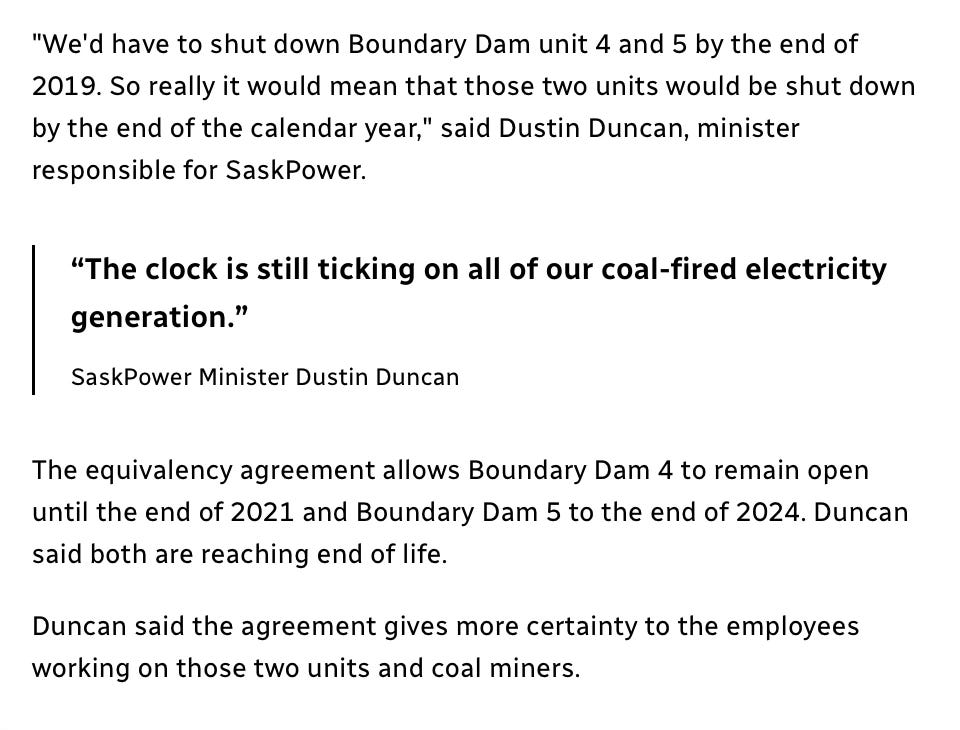
Seven years, one election and one new minister later, the province reversed course — and delivered the news in a letter to SaskPower employees, not to the public: every coal unit in Saskatchewan gets a life extension, and, while we’re at it, the province “does not recognize the legitimacy” of the federal regulations that require coal to shut down.
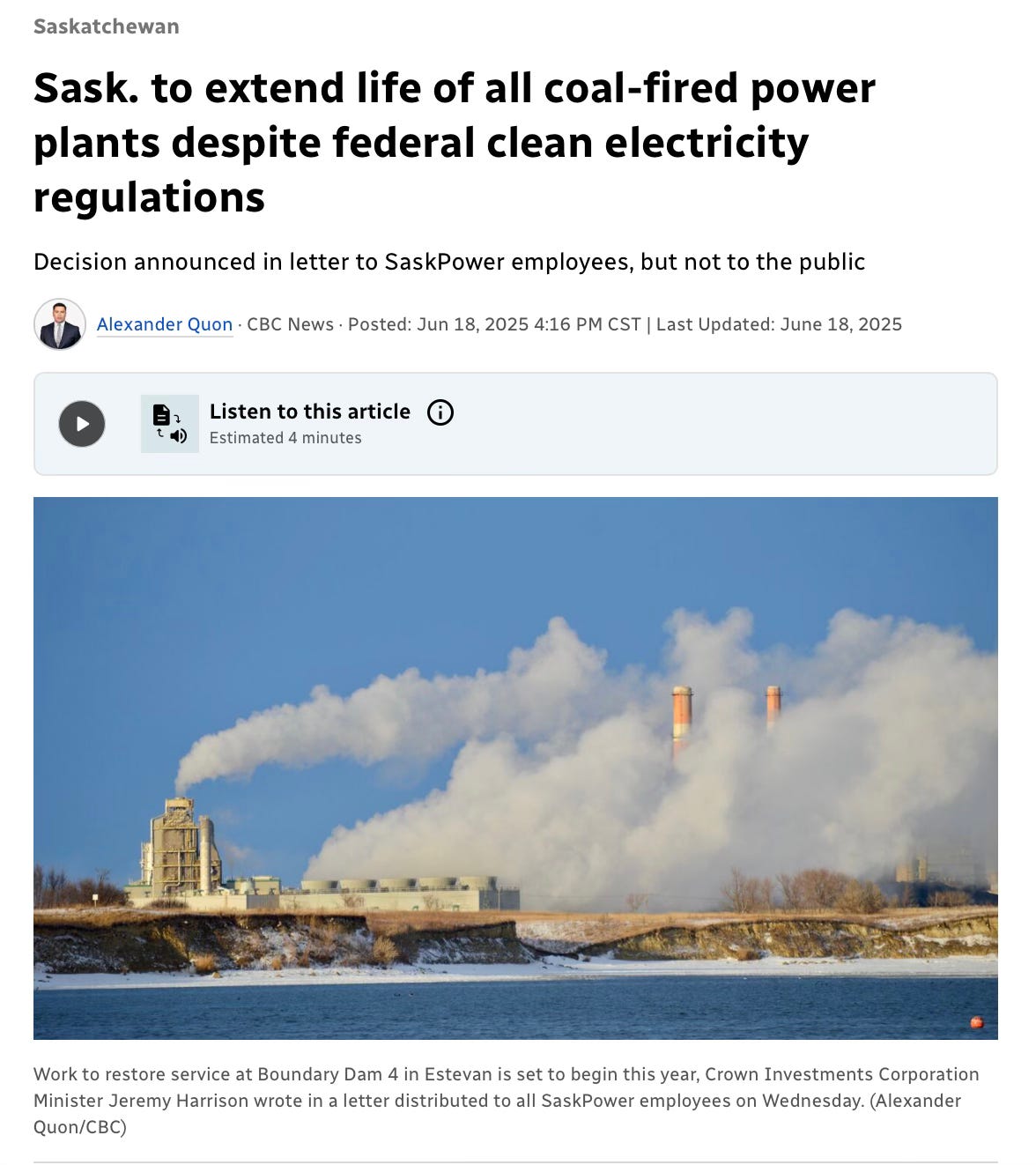
The equivalency agreement that made any of this legal expires on December 31, 2026.
After that, there’s nothing. Just coal, past its legal death date, humming along on defiance.
The bill for this nostalgia is already past due. The official refurbishment estimate has nearly tripled in under a year, to $2.6 billion. A leaked SaskPower memo puts the full 25-year plan at $26 billion, projects electricity rates up 20 per cent by 2030 and 95 per cent by 2040, and rates the plan’s own regulatory risk as “extreme” — while noting that wind and solar would deliver the same energy for roughly half the price.
The government’s response was to call a billion-dollar discrepancy in its own numbers an “incomplete, early draft.”
And here is the sentence SaskPower filed, in writing, with its own rate review panel: “The decision to operate coal beyond its regulated end of life has allowed SaskPower to have supply available to accommodate the Bell data centre load.”
The same filing requests 3.9 per cent rate increases in each of 2026 and 2027. Read those sentences back to back. Ratepayers fund the coal. Bell consumes the coal.
That’s not an investment.
The environmental record is even better. Saskatchewan never conducted an environmental impact assessment on the original project — “not all projects require assessments,” the Ministry of Environment shrugged.
When Saskatchewan citizens formally asked Ottawa to designate the project under the Impact Assessment Act, the agency declined this June, because the physical work had “substantially begun.”
In other words, construction started before the regulators could do their job, and the speed was used as a shield. Now we’re doubling down on 900 megawatts of brand-new unabated natural gas on the most carbon-intensive grid in Canada, and the expanded footprint was waved through under a framework that is six weeks old.
Bell’s closed-loop water promise? Lovely. It’s another talking point, not a permit condition, and nobody has disclosed the fill volumes or the failure contingencies. And if carbon law tightens — as every projection says it will — who eats the cost of 900 megawatts of stranded gas turbines? A policy brief from the Johnson Shoyama School asked exactly that in June. The silence has been deafening.
As for the democratic process: the RM of Sherwood approved this project in April after the province appointed four new Sask Party partisan councillors following a wave of resignations, while protesters gathered outside the meeting. The expansion — the quadrupling — arrived with, in the words of NDP critic Brittney Senger, “absolutely zero public consultation.” Senger asked where the power comes from, what the water use is, what it costs taxpayers, who benefits.
Those aren’t radical questions. They are the questions.
Now let’s talk about the money, because the numbers deserve an honest accounting.
The original “$12 billion in economic value” combined Bell’s $1.7 billion with roughly $10 billion of computing hardware owned by the campus’s two anchor tenants — Cerebras and CoreWeave. Both American. Both subject to the U.S. CLOUD Act. Neither under any publicly disclosed obligation to stay.
“Sovereign AI” — the phrase doing all the heavy lifting here — has no binding definition in anything, anywhere.
We are betting Saskatchewan’s entire generating capacity on a market the tenant itself describes as lukewarm.
Divide the headline number by the permanent jobs — 500, including 100 head-office positions — and you get roughly $100 million per permanent job.
American evidence reviewed by University of Regina researchers says the most automated hyperscale campuses run on 20 to 30 staff. The “3,000 additional jobs” have never been defined. For comparison’s sake: when BHP wanted 300 megawatts for the Jansen mine, Saskatchewan extracted binding employment targets, procurement commitments and a royalty regime, because we held the power and acted like it.
British Columbia now auctions scarce power to the highest bidder. In Cedar LNG, British Columbia negotiated majority Indigenous ownership. Bell got three Crowns’ infrastructure, a posted rate, and a workforce MOU — no equity, no penalties, no local-content guarantees. Watson said he’d “worn out his shoe leather” building demand for sovereign AI. I bet he did.
And here is what should genuinely terrify every Sask Party MLA, supporter and Saskatchewan fucknut whose entire livelihood depends on government contracts, because this is not a hypothetical: the rest of North America has already rendered its verdict on AI data centres.
It’s a hard no.
In the United States, 71 per cent of Americans now oppose an AI data centre in their own area — 48 per cent strongly— and only one in nine supports building them at all. Opposition nearly tripled in eighteen months, and it cuts across party lines: 75 per cent of Democrats, 74 per cent of independents, 63 per cent of Republicans.
The issue of AI data centres has already decided primaries — an outspoken data-centre critic just won a Democratic congressional nomination in Michigan against two seasoned rivals— and candidates in both the Dem and GOP parties are now running ads against data centres, with governors in Texas and Pennsylvania publicly reversing course to survive.
Sixteen US states are weighing AI data centre bans.
A hundred-plus municipalities have passed moratoria against them.
In the communities that have hosted these things longest, the receipts are in: ratepayers absorbing billions in grid costs, Virginia families documenting years of sleep loss and headaches from Data Center Alley.
Canadians aren’t far behind: 68 per cent would oppose a large data centre near their home, Oakville and Mississauga have both frozen new construction, and there have already been protests in Regina and Saskatoon.
So no, this is not a Saskatchewan-only debate, and the Sask Party cannot claim they didn’t know. Every risk that turned the public against this industry — the power bills, the water, the noise, the gas turbines, the phantom jobs — is present in the Bell deal, several of them amplified by the province’s own documents: the leaked memo projecting electricity rates up 95 per cent by 2040, the coal plant revived to serve the load, the American tenants, the missing environmental assessment.
Every other government on the continent is reading this polling and scrambling — pausing, auditing, legislating guardrails. And Scott Moe’s response is to quadruple down… which leaves exactly two readings:
1) Scott Moe, Jeremy Harrison and their cronies genuinely cannot see the writing on its tombstone — or
2) they have read it, and don’t care because they know they won’t be around when it’s carved.
I don’t know which explanation is true. I know the terms are secret, and secrecy is how you’d run it if it were the second one. Once Moe et al are gone they’ll be counting their brand new shiny stock options, a lá Brad Wall and the oil and uranium industries.
Explained: The Absolute Audacity of Brad Wall

The carbon capture and sequestration (CCS) technology former premier Brad Wall’s been touting as a success story for Whitecap Resources…
I’ve said it before: Brad Wall degraded the integrity of the premiership the moment he walked out the door and straight into stock options from companies he’d been dealing with for years in office. I simply do not believe Wall did not know what was waiting for him.
Which means Scott Moe knows too — and probably a lot of other Sask Party Cabinet Ministers as well. They already know which seats are warm, which options are vesting, which boardrooms are expecting them.
That’s who today’s Sask Party MLAs, Ministers and hacks are actually working for.
Definitely not you.
As for Mark Carney - how am I to draw any other conclusion than the man is a sweet talker, but could care less about what Saskatchewan people actually want? What they need?
“We will protect what is ours,” Moe declared in Toronto.
This is not nation-building. This is a fire-sale.
I live in a low-populated, developing country that relies solely on Mexico for its power. About six weeks ago the rolling blackouts started. The notices we receive in advance make it clear that Mexico is making the choice to cut us off, because their own capacity is too low to serve us.
Guess what Mexico’s been doing?
They don’t even have enough power and water to handle themselves anymore. Yet one of the reasons Mexico is exploding with data centres is just like Saskatchewan, the country’s government is a corrupt three-ring circus and doesn’t require environmental assessments.
Saskatchewan is building megaprojects like they do rural Mexico.
Have you ever been off-resort in Mexico, nevermind rural Mexico?
If you have, you know it’s not exactly a place other countries look at and think “You know, that region is one we should emulate.”
I’m rarely speechless, but this one is just jaw-dropping.
Demand that Scott Moe name the new power plant partner, release the deal terms, and run the environmental assessment.
Or burn with the rest of the province. Whatever.
It really is up to each one of you.

One of the most consequential changes to Saskatchewan power in generations. Saskatchewan has paralyzed Saskatchewan Power and we will all pay for it. AI centres may well become the white elephant of the 2020s.
SaskPower flyer: Your Power™️, by Bell.